Why Public Bodies Have Different Names and Roles
Why public bodies have different names and roles: learn to identify who is responsible, avoid misleading labels and find the right route for a question.
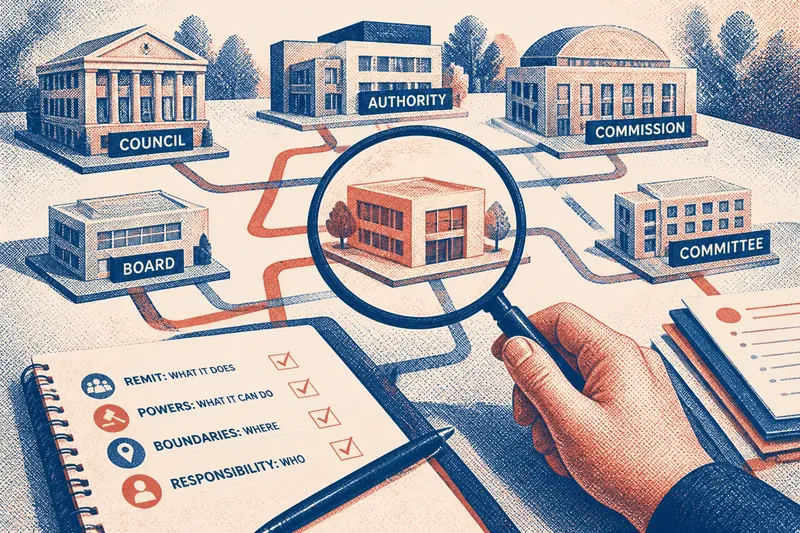
You have found a public body named in a letter, but its title does not tell you whether it can answer your question, make a decision or only offer advice. Understanding why public bodies have different names and roles helps you identify the right institution before you spend time contacting the wrong one.
Names such as board, authority, council, commission and committee are clues, not complete descriptions. The same word can refer to bodies with different powers, while bodies with different titles can perform similar tasks. The useful question is not simply “What is it called?” but “What is it responsible for, and where does that responsibility come from?”
Why does a familiar title lead to the wrong place?
Titles are often broad labels. A council may be a local elected authority, an advisory group within an organisation or a small committee responsible for a particular service. An authority may oversee a defined public function, but the word alone does not say which function, what area it covers or how much discretion it has.
This creates a common problem: a reader recognises a word and assumes the body’s role. The assumption may be reasonable, but it can send a request to an office that cannot act on it. A familiar label is like the name on a drawer: useful for orientation, but not proof of what is inside.
What to try: Look for the body’s full formal name, including any words that narrow its remit, such as “planning”, “licensing” or “advisory”. Then check the description attached to that name on an official public source. If the description does not say what it can decide or administer, do not infer those powers from the title.
Why do similar bodies have different responsibilities?
Public responsibilities are allocated through laws, formal rules and arrangements between institutions. A body may be created to carry out a particular function, advise another body, oversee a service or coordinate work across several organisations. Its title may reflect its history or administrative structure rather than a plain-language account of its authority.
It also helps to separate a body’s remit from its powers. A remit is the area of work assigned to it. Powers are the actions it is legally or formally able to take within that area. A group can have a remit to review a service yet lack power to change the service itself. Another body may make the decision, while staff or a separate agency carry it out.
What to try: Find wording that describes both the subject area and the body’s permitted actions. Look for verbs such as “advise”, “approve”, “regulate”, “deliver”, “investigate” or “administer”. These verbs are more revealing than a title because they describe what the institution is expected or authorised to do.
Why does a body’s name change across documents?
Public records may use a short name, a formal name, a previous name or the name of a parent organisation. A service might be associated with one institution, delivered by another and overseen by a third. A letterhead may name the organisation that employs staff, while a decision notice identifies the body that made the decision.
That difference does not necessarily mean the records conflict. They may be describing separate parts of a process. It becomes confusing when a document uses “the department”, “the board” or “the authority” without first making clear which organisation those words refer to.
What to try: Compare the exact names and roles in the document, rather than treating every reference as interchangeable. Check who issued it, who signed or authorised it, and which body the text says is responsible for the action. If the connection remains unclear, ask the contact named in the document to identify the decision-making body and the organisation handling the work.
Why do boundaries and overlaps make responsibility hard to trace?
Institutions are often responsible for different places, topics or stages of a service. A local body may handle a matter within its area, while a national body sets rules or supervises a broader system. Two bodies may also share a subject but have distinct roles: one collects information, another assesses it, and a third makes a formal determination.
Overlapping responsibilities can leave people unsure where to begin. One office may receive a query without having authority to settle it; another may have authority but depend on information gathered elsewhere. The fact that several bodies appear in a process does not mean each can answer every question about it.
What to try: Match your question to the kind of action you need. For a service problem, identify who delivers the service. For a formal decision, identify who has authority to make or review it. For a policy or rule, check which body sets or administers it. If a boundary depends on location or subject, use the official remit description to establish the relevant area before contacting an office.
What should you check when the role is still unclear?
How can I tell whether a body makes decisions?
Look for a clear statement that it can approve, refuse, determine or issue a formal decision on the matter. A body that discusses or recommends an option may influence the outcome without having authority to decide it.
Does an advisory body have no influence?
No. Advice can inform a decision, set out specialist views or draw attention to consequences, even when another institution makes the final choice. Check who receives the advice and whether the receiving body must consider or respond to it.
Why do several organisations appear on one public service?
One organisation may set the rules, another may fund or oversee the service, and another may provide it directly. Read the document for the specific action each is responsible for, rather than assuming that a shared subject means shared authority.
What if official descriptions disagree?
Check whether the pages describe different dates, locations or stages of responsibility. If the mismatch affects where you should send a request, ask the relevant organisation to confirm its current role and direct you to the responsible body.
How can you trace a responsibility without guessing?
Use a short sequence of checks. Start with the body’s full name, then find its official description of responsibilities. Next, identify the action you need and look for the body authorised to take it. Finally, check whether another institution handles delivery, review or oversight. This keeps the search focused on function rather than labels.
- Record the full name. Include any regional, service or subject terms that distinguish it from similarly named bodies.
- Find the stated remit. Use an official page, published rules or the relevant public document.
- Note the action verb. Separate making a decision from advising, administering, delivering or reviewing.
- Check the boundary. Confirm whether the responsibility applies to your location, type of issue or stage of a process.
- Follow the named route. Use the contact or referral given for that specific responsibility, not a general assumption based on the title.
Say you receive a notice from the Northfield Transport Board about a bus route, and you want to know who can change the timetable. The notice says the board advises the regional transport authority, while the authority approves service plans and a contracted operator runs the buses. You would ask the authority about approval, the operator about day-to-day service and the board about its advice. The names alone would not have shown that division; the verbs in the notice do.
When should you ask the institution to clarify its role?
Ask when the published description leaves a practical question unanswered: who can issue a decision, which office handles a review, or whether the body covers your area. A focused enquiry is easier to route than a broad request to “explain the organisation”. State the matter briefly and ask which body is responsible for the particular action you need.
If the issue concerns a legal right, an appeal deadline or a formal procedure, rely on the relevant official notice and seek advice from a qualified professional where appropriate. General descriptions of institutional roles cannot settle the requirements of an individual case.
To understand why public bodies have different names and roles, treat every title as a starting point, then verify the remit, powers and specific action involved. That habit helps you distinguish the organisation that speaks about an issue from the one that can act on it, and gives your question a clearer route to the right place.