A First Public Meeting: A Listening Plan for a Busy Evening
A first public meeting listening plan helps you follow the subject, record useful questions and hear which parts of a proposal remain undecided.
At a public meeting, a speaker may describe a proposal while another discusses a deadline, and the chair may move the conversation on before you have sorted either out. A first public meeting listening plan can help you keep track of the subject, note questions and hear what remains undecided, even if you have only part of the evening to attend.
The aim is not to capture every sentence or prepare a speech. It is to leave with a clear account of what the meeting was discussing, what participants said they still needed to resolve, and what you want to check afterwards. Choose the approach that fits your time and attention.
Which listening approach suits your evening?
Three approaches work for different circumstances. You can listen for the meeting’s overall direction, follow one topic closely, or divide attention between a few agenda items. Each is useful; none requires a complete transcript.
- Broad listening: Track the subject, the main positions and the next stated action. This suits a first visit or a meeting with several topics.
- Focused listening: Follow one agenda item from its introduction through discussion and any stated outcome. Choose this if one subject matters most to you.
- Selective listening: Identify a few agenda items in advance and listen closely when they come up, while noting what happens around them. This suits a limited attendance window.
Think of your notes like a map rather than a recording: they should help you find the main turns, not preserve every footstep. If you are unsure, start broadly. You can move into focused listening once you hear which topic is actually under discussion.
What should you prepare before you arrive?
Read the meeting notice and agenda if they are available. The agenda gives you the published sequence of business; it does not tell you everything speakers will say or settle. Find the item most relevant to you, note its wording, and look for any named report or proposal linked to it.
Write a one-line description of the subject in your own words. Keep it neutral. “Changes to the route and access arrangements” is more useful than “the plan that will close the road” if the published item does not say that closure has been decided.
Make a small note page with three prompts:
- Subject: What issue or proposal is being discussed?
- Questions: What needs clarification, and who might be able to answer?
- Open points: What did speakers say is still unresolved, under review or awaiting a later decision?
Leave room beneath each prompt. A crowded page encourages you to write down fragments without checking what they mean. If you are attending remotely, have the agenda and a blank note page open; if you are in the room, a pen and the agenda are enough.
How can you tell what is settled and what is still open?
Listen for the difference between a description, a view and a clear statement about the process. Someone may describe a proposal, express support or concern, or explain what decision is expected next. These are not interchangeable. Note who is speaking and the wording that signals the status, rather than turning an impression into a fact.
Words such as “proposed”, “under consideration” and “subject to further work” can indicate that an issue remains open. A statement that a decision has been made may identify who made it or refer to an earlier meeting. If the wording is unclear, write down the uncertainty itself: for example, “Is this a recommendation or the decision?”
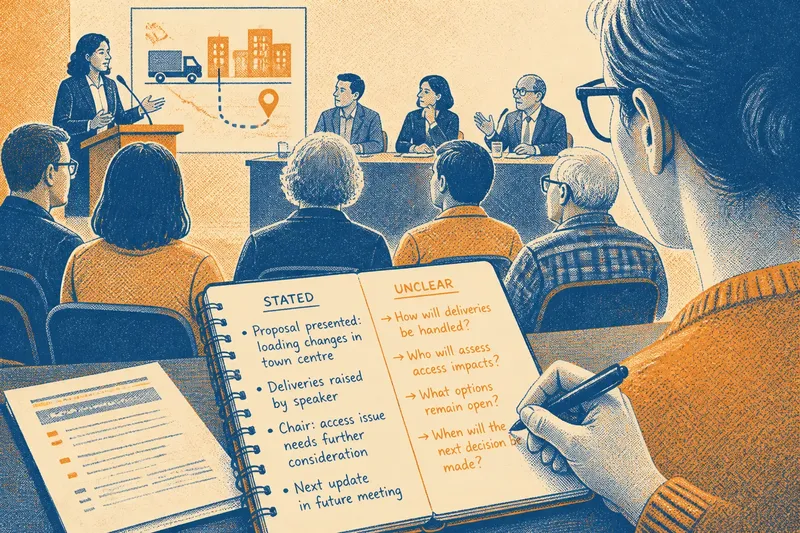
Separate what you hear into two columns: stated and unclear. Under “stated”, record points directly expressed in the meeting. Under “unclear”, put questions about timing, responsibility, options or the next stage. This simple division makes it harder to mistake a confident tone for a settled outcome.
How should you handle questions and missed details?
You do not need to ask every question aloud. First note what would help you understand the subject: what part of the proposal is being considered, which options remain open, or what information is expected before the next discussion. A question that identifies the missing point is usually more useful than a broad request for the whole issue to be explained again.
Follow the meeting’s stated arrangements for public questions or comments. Some meetings invite them at a particular point; others may have different rules. If you do speak, keep the question tied to the agenda item and leave room for a direct answer. If you are not called on, the written note still helps you check the relevant public material later.
If you miss a passage, do not guess at it. Mark the time or agenda item, then return your attention to the current discussion. A gap in your notes is less damaging than a confident but inaccurate reconstruction.
What should you check after the meeting?
Review your notes while the sequence is fresh. Mark which questions were answered, which remain open and any next action that was explicitly stated. Keep your own interpretation separate from the meeting’s wording; a short quotation or precise paraphrase can make that distinction clear.
Imagine you attend a meeting where a town centre loading proposal is discussed. You note that the proposal describes a possible change, that a speaker asks how deliveries would be handled, and that the chair says the access issue needs further consideration. Your useful record is not “the change was approved”; it is that access remains an open point and should be checked in the next public update.
Check the relevant meeting papers or later record if you need to confirm what happened, especially when a speaker refers to another document or a future decision. The record may clarify the formal outcome, while your notes preserve the question you wanted answered. Local meeting rules and the wording of official material can differ, so use the meeting’s own published guidance where it matters.
Which questions are worth keeping on your page?
How do I choose which agenda item to follow?
Pick the item that connects most directly to your concern or the one you can attend from its opening discussion to its stated outcome. If several matter, use broad listening and mark each item you want to revisit.
What if the discussion uses unfamiliar terms?
Write the term down alongside the sentence or agenda item where it appeared. Avoid guessing at its meaning; check the meeting papers or ask for clarification through the available public channel.
Can I leave before the meeting ends?
Yes, if you need to, but note which items you heard and where you left. Do not treat an unfinished discussion as a decision, and check later records for the remaining business.
What should I do if nobody answers my question?
Keep it under “unclear” and note any person, office or later document named as a possible source. Follow up through the public contact route provided for the meeting, keeping your request specific.
For a first visit, a broad first public meeting listening plan is often the easiest choice: track the subject, capture your questions and mark what speakers leave unresolved. You can then choose a more focused approach next time, based on what the meeting itself made clear you need to hear.